


Rotax technical scrutineering: what the scrutineers check in 2026

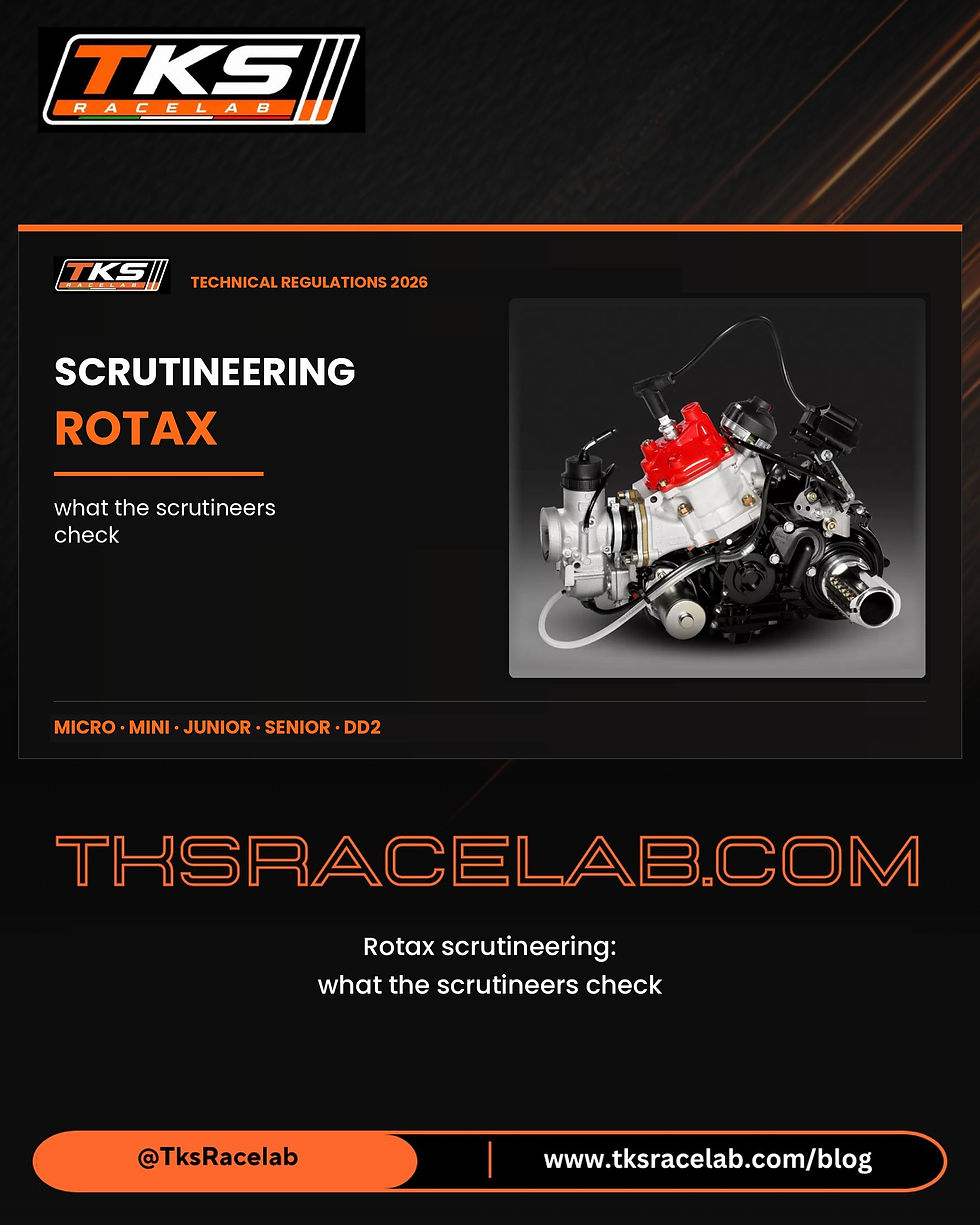
In short At Rotax technical scrutineering the engine is presented sealed, with the seal intact and the engine identity card stamped. At the race the scrutineers mainly check what sits outside the seal: carburettor, exhaust, radiator, spark plug, ignition, fuel and oil, tyres and the weight of the kart with the driver. The engine can still be opened before or after the race or after a protest, and then everything is measured: squish, cylinder, con rod, crankshaft and reed valve. The basic rule is one: anything the regulations do not explicitly allow is forbidden.
How technical scrutineering works at Rotax races
In Rotax MAX Challenge races, in Italy as in the rest of the world, the engine arrives at the track already checked and sealed by an authorised Rotax distributor or one of its service centres. The seal closes the inside of the engine and its number is written on the engine identity card.
That is why at scrutineering the engine is not stripped at every race. The scrutineers check that the seal is intact and matches the card, and then they check the ancillaries. How sealing works is explained in our guide on the Rotax engine seal.
Presenting the kart at scrutineering counts as a declaration that everything complies. The regulations are clear: making sure that everything outside the seal complies is the competitor's responsibility.
What you must bring to scrutineering
Under the RMC Italia 2026 technical regulations, at scrutineering the driver must present:
the engine, or engines, with the seals intact;
the engine identity card with the engine serial number, the seal number, the stamp and the signature of whoever checked and sealed the engine.
In Italy only seals with the Italian bar code are allowed and, for the Italian RMC, only engines imported by the Rotax importer for Italy. During the event service centres cannot reseal an engine between scrutineering and the final.
For each event, from qualifying practice to the final, the 2026 regulations allow a maximum of 1 chassis, 1 set of dry tyres, 1 set of wet tyres and 2 engines.
What the technical scrutineers check

Outside the seal, the checks done at every race:
Carburettor: Dell'Orto VHSB 34 marked XS, duct with cast surface, original vent pipe, original needle and jets. The idle adjustment screws and the needle position are free.
Exhaust: only the original exhaust socket and silencer for the category, with the original silencer wadding and 2 to 4 springs. On Micro and Mini the exhaust socket has a maximum diameter and the silencer is sealed by the scrutineer.
Spark plug and ignition: only NGK GR8DI or GR9DI, original plug cap, original ignition unit and wiring loom.
Radiator and cooling: water only, without additives.
Fuel and oil: the scrutineer can replace them at any time with those from parc fermé.
Tyres: only the MOJO tyres specified for the category, without treatments.
Weight: kart with driver, weighed after every official session.
Inside the seal, the checks done when the engine is opened: squish, cylinder height and ports, piston and ring, piston pin, con rod, crankshaft, bearings and reed valve.
The measurements checked most often
These are the measurements checked most often. The values are those of the 2026 technical regulations:

Spark plug: NGK GR8DI or GR9DI for all categories. Maximum electrode gap 1.20 mm on Micro and Mini, 1.00 mm on Junior, Senior and DD2: a feeler gauge of that size must not pass through.
Cylinder height: 87.00 mm on Micro, Mini, Junior and Senior, 86.70 mm on the DD2, with a tolerance of 0.1 mm over and 0.05 mm under.
Exhaust socket: on Micro MAX maximum inner diameter 18.20 mm, on Mini MAX 22.10 mm. Junior, Senior and DD2 use only exhaust socket 273190.
Oil: XPS Castor Racing Oil 2T at 2% in the RMC Global regulations. In the RMC Italia 2026 regulations 2% applies to Junior, Senior and DD2, while Micro and Mini use 1.5%.
Cooling: water only, without additives.
Gear ratio: on Micro MAX sprocket 14 and rear sprocket 72, on Mini MAX sprocket 13 and rear sprocket 80. Fixed.
Squish: it has a different minimum for each category. How it is measured is explained in our guide on how to measure squish on Rotax engines.
Measurements taken with a precision of 0.10 mm or finer are valid only with the part between 10 and 30 °C: a hot cylinder just off the track is not measured.
The minimum weight of the kart with the driver
You go on the scales with the kart and all your safety gear: helmet, suit, gloves. The official scales are those in the service park and weighing takes place after qualifying, heats and races.

125 Micro MAX: 105 kg
125 Mini MAX: 115 kg
125 Junior MAX: 145 kg
125 Senior MAX: 162 kg
125 Senior MAX Masters: 175 kg
125 MAX DD2: 175 kg
125 MAX DD2 Masters: 180 kg
Underweight means exclusion from the session, or in the final being classified last. Before weighing nothing can be added to or removed from the kart. A small bottle of drinking water is tolerated, but anyone who pours water over their head or suit gets a 1 kg weight penalty.
The five mistakes that lose you a race at scrutineering
Damaged seal or engine card not in order. Check it before you leave home.
Wrong spark plug or electrode gap too wide. Non original spark plugs with an extended electrode are forbidden.
Silencer with non original wadding or badly replaced rivets. The wadding is replaced only with the original Rotax one.
Coolant with antifreeze or additives. Water only.
Weight on the limit. Weigh yourself with the kart after free practice, and set the ballast with a margin.
Our advice
Before every race do a check as if you were the scrutineer: look at the seal and the card, measure the spark plug, check carburettor and exhaust, weigh yourself with the kart. Twenty minutes in the workshop are enough and they save you from losing a whole race over a part that costs a few euros.
If you need an original spare part to bring the engine back into spec, the shop has the full Rotax catalogue. And if you want an opinion before the race, message us.
Frequently asked questions about Rotax technical scrutineering
What must I bring to Rotax technical scrutineering?
The engine with the seals intact and the engine identity card, with serial number, seal number and the stamp and signature of the centre that checked and sealed it.
Can the scrutineers open my engine?
Yes. They can ask for it to be opened and checked again before or after the race or in case of a protest. If the seal is broken, the engine must be checked and resealed by an authorised Rotax distributor or one of its service centres.
Which spark plug is allowed in Rotax engines?
Only the NGK GR8DI or GR9DI. The maximum electrode gap is 1.20 mm on Micro and Mini and 1.00 mm on Junior, Senior and DD2.
How much must a Senior MAX kart weigh with the driver?
At least 162 kg under the 2026 regulations, with the driver on board and all the safety gear.
Can I put antifreeze in the radiator?
No. In Rotax engines the coolant must be water only, without additives.
Which oil is used in Rotax races?
XPS Castor Racing Oil 2T. The percentage is 2% in the RMC Global regulations, while in Italy the 2026 regulations specify 2% for Junior, Senior and DD2 and 1.5% for Micro and Mini.
Sources: Global RMC Technical Regulation 2026 and Bulletin; Global RMC Sporting Regulation 2026, articles 1.2, 3.5, 12 and 19; Rotax Max Challenge Italia 2026 Technical Regulations V2.1, chapters 2 and 3.
Questions about this topic?
Message us on WhatsApp: we answer personally, with the experience of people who live at the track. And if you want to drive a real racing kart, with Arrive & Drive you get into one of ours, ready on track. The right spare part? You will find it in the shop.
Arrive & Drive Pro by TKS RaceLab: 2026 karts with Rotax Senior MAX and DD2 engines, Alfano 7 telemetry and trackside technical support at Lonato, Franciacorta, Cremona and Ala. Message us on WhatsApp for information and availability.
TKS RaceLab | Performance Engineering Karting | tksracelab.com
Read also: Rotax engine seal and technical regulations → · How to measure squish on Rotax engines → · Kart minimum weight and ballast → · Rotax MAX spark plug → · Rotax crankshaft → · Rotax reed valve → · Rotax Grand Finals 2026 → · Rotax engine exploded view → · Rotax Global App →
📞 Contact
📞 +39 352 0280 133
Author: Sergio, TKS RaceLab | Published: 22 October 2026
TKS RaceLab is the Italian online store dedicated to karting: spare parts, accessories and everything you need to get on track. With Arrive & Drive you arrive at South Garda Karting (Lonato), Franciacorta, Cremona or Ala and find your kart ready to go. No hassle, just driving.


Comments