


Rotax reed valve: check, reeds and Micro and Mini kit


In short The Rotax reed valve is the valve that lets the mixture into the crankcase and stops it from flowing back towards the carburettor. It has two three-petal reeds, 0.6 mm thick, held by two curved stoppers that must not be straightened: the distance between the stoppers must stay above 16.70 mm. On the Micro and Mini MAX two spacer plates are mandatory, and they come with kit 281551. It is checked every time the carburettor comes off: rubber intact, reeds without cracks and no light between reed and valve body.
What the reed valve does in the Rotax engine
On the Rotax 125 MAX evo and the 125 MAX DD2 evo the reed valve sits between the carburettor and the cylinder. When the piston goes up it creates a vacuum in the crankcase, the reeds open and the mixture flows in. When the piston goes down the crankcase pressure closes them against the valve body, so the mixture does not flow back towards the carburettor.
It is a simple valve, but it works thousands of times a minute. A cracked reed or one that does not seal properly shows up immediately: the engine runs unevenly, fouls the spark plug, the carburation changes and it loses pull in the mid range.
How the Rotax reed valve is made
The valve has a body with a rubber coating and two identical sides. On each side there is a reed with three petals and a curved reed stopper, fixed with M3x6 screws. Between the valve and the cylinder there is the gasket.

Starting from the valve body, the assembly order is:
Reed, with the concave side facing the valve body. The reed is slightly curved, not flat: fitted the wrong way round it does not seal.
Spacer plate, only on Micro and Mini MAX. It has a cut on one side that must line up with the one on the reed.
Curved reed stopper, which limits how far the petals open.
M3x6 screws with threadlocker.
Once the reed is fitted, hold the valve up to the light: no light must pass between reed and valve body. If it does, the reed is not sitting properly and must be adjusted by loosening and retightening the screws.
The reed valve measurements in the 2026 regulations
The reed valve is inside the engine seal and the 2026 technical regulations set precise measurements.

Reeds: two, each with three petals, thickness 0.6 mm with a tolerance of 0.10 mm either way.
Reed stoppers: two, curved. Straightening them is forbidden.
Distance between the two stoppers: must be greater than 16.70 mm. It is measured with a digital calliper from the inside of the stoppers, in line with the centre of each petal.
Gaskets between valve and cylinder: up to 2.
Reed valve tightening torques
M3x6 reed screws (part number 240351): 1.5 to 2 Nm, with strong threadlocker.
M6x25 carburettor flange screws: 7 Nm.
The reed valve screws are small and the torque is low: tighten them with a suitable torque wrench, not by feel. A screw that is too tight deforms the stopper, one that is too loose lets the reed move.
Micro and Mini MAX: reed valve kit 281551
On the Micro MAX and Mini MAX the 2026 regulations make two spacer plates mandatory, one per side, fitted between the reed and the curved stopper. They come with update kit 281551, which takes the valve from version 224380 to 224382.
How the kit is fitted:
Remove the three original screws, the curved stopper and the reed.
Screw the three old screws into the valve body by hand and tighten them to 1.5 Nm without lubricant: this cleans up the thread. Then remove them and throw them away.
Clean every metal residue off the valve body.
Refit in order reed, spacer plate lined up with the cut on the reed, curved stopper and the new M3x6 screws from the kit, at 1.5 Nm.
Repeat on the other side.
If the valve touches the cylinder wall on the intake side, fit the second gasket 250523 to get a good seal.
To make it visible at scrutineering, on the Micro and Mini an M6 washer goes under the screw that carries the seal, so the scrutineer sees straight away that the spacer plates are fitted.
What to check when you remove the reed valve
Every time you take the carburettor off, have a look at the reed valve too. There are four checks and they take a few minutes.
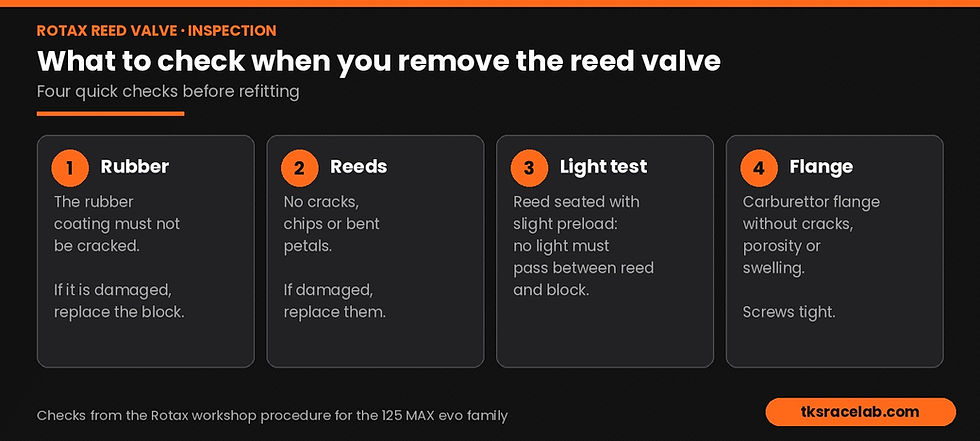
Valve rubber: the coating must not be cracked or hardened. If it is, replace the complete reed valve.
Reeds: no cracks, chips or bent petals. If they are damaged, replace them.
Light test: the reed must rest with a slight preload, with no light between reed and valve body.
Carburettor flange: no cracks, porosity or swelling, screws tight.
Reed valve spare parts
In the shop you will find the original Rotax spare parts for the intake group:

Rotax evo 20 reed valve, part number 224380.
Rotax evo 20 reeds, part number 224431: you need two per valve.
Rotax reed valve gasket, part number 250523.
Always keep a couple of reeds and a spare gasket in your toolbox: they cost little and a cracked reed stops you in a race.
Frequently asked questions about the Rotax reed valve
How often should the reed valve be checked?
Every time the carburettor is removed and at every engine rebuild. Look at the valve rubber, check the reeds and make sure no light passes through.
How thick are the Rotax reeds?
The reeds are 0.6 mm thick, with a tolerance of 0.10 mm either way. Each valve has two reeds with three petals each.
Can I straighten the reed stoppers?
No. The 2026 regulations forbid straightening the curved stoppers. The distance between the two stoppers must stay greater than 16.70 mm.
How many gaskets can I fit between valve and cylinder?
Up to two. The second gasket 250523 is used when the valve touches the cylinder wall on the intake side.
Is kit 281551 mandatory on the Mini MAX?
Yes. On the Micro MAX and Mini MAX the two spacer plates are mandatory and they come with kit 281551.
What torque do the reed screws need?
The M3x6 screws are tightened to 1.5 to 2 Nm with threadlocker. The M6x25 carburettor flange screws to 7 Nm.
Sources: BRP-Rotax, Repair Manual 125 MAX evo, edition 1 April 2024; Rotax Tech Tip 05; Illustrated Parts Catalog 125 MAX evo 2025; Global RMC Technical Regulation 2026, article 5.6.1; Rotax Max Challenge Italia 2026 Technical Regulations V2.1; Rotax 2026 spare parts price list.
Questions about this topic?
Message us on WhatsApp: we answer personally, with the experience of people who live at the track. And if you want to drive a real racing kart, with Arrive & Drive you get into one of ours, ready on track. The right spare part? You will find it in the shop.
Arrive & Drive Pro by TKS RaceLab: 2026 karts with Rotax Senior MAX and DD2 engines, Alfano 7 telemetry and trackside technical support at Lonato, Franciacorta, Cremona and Ala. Message us on WhatsApp for information and availability.
TKS RaceLab | Performance Engineering Karting | tksracelab.com
Read also: Dell'Orto VHSB 34 XS carburettor → · Rotax jetting in hot, cold and wet weather → · Rotax MAX torque settings → · Rotax Junior to Senior conversion kit → · Rotax technical scrutineering → · Rotax engine exploded view →
📞 Contact
📞 +39 352 0280 133
Author: Sergio, TKS RaceLab | Published: 22 October 2026
TKS RaceLab is the Italian online store dedicated to karting: spare parts, accessories and everything you need to get on track. With Arrive & Drive you arrive at South Garda Karting (Lonato), Franciacorta, Cremona or Ala and find your kart ready to go. No hassle, just driving.


Comments