


How to Measure Squish on Rotax Engines: Procedure and 2026 Minimum Values

Updated: 4 days ago

In short Squish is the gap between the piston at top dead centre and the combustion chamber insert. Under the 2026 Rotax technical regulations the minimum is 2.40 mm on the Micro MAX, 1.20 mm on Mini and Junior, 1.00 mm on the Senior and 1.30 mm on the DD2. It is measured with a solder wire crushed by the piston, on the left and on the right in the direction of the piston pin, and the average of the two readings counts. It is corrected by changing the thickness of the cylinder base gasket.
What squish is and why it matters on Rotax engines
Squish is not something specific to Rotax engines: it is a measurement taken on two-stroke kart engines and beyond. It is the gap between the piston, at top dead centre, and the combustion chamber insert. It is only a few tenths of a millimetre, but it affects the power characteristics of the engine and how smoothly it runs.
The rule to remember is simple: the smaller the squish, the higher the compression. With a smaller squish the engine becomes more sensitive to carburation when temperature, air pressure and humidity change. That is why squish on Rotax engines is not free: the regulations set a minimum for each class.

Minimum squish values on Rotax engines in 2026
These are the minimums of the RMC Global Technical Regulations 2026 (article 5.1), the same as the RMCI Italy 2026 technical regulations V2.1 of 7 April 2026:
• 125 Micro MAX: 2.40 mm, with 3 mm solder (Rotax 580132).
• 125 Mini MAX: 1.20 mm, with 2 mm solder (Rotax 580130).
• 125 Junior MAX: 1.20 mm, with 2 mm solder (Rotax 580130).
• 125 Senior MAX and Masters: 1.00 mm, with 2 mm solder (Rotax 580130).
• 125 MAX DD2 and Masters: 1.30 mm, with 2 mm solder (Rotax 580130).
The average of the two readings, left and right, is what counts. The RMCI regulations state that the minimum has no tolerance: 0.99 mm on a Senior is outside the rules.

On the Micro MAX, to reach 2.40 mm, the RMCI regulations make the Rotax 626420 aluminium gasket mandatory, with at least two paper gaskets: one below and one above the aluminium one. The same set-up is written in the Global 2026 technical regulations.
Why squish is a delicate measurement
• It is inside the engine seal. The regulations list squish among the technical specifications inside the engine seal. To correct it you have to open the engine, and an engine with a broken seal must be checked and resealed by an authorised Rotax distributor or one of its service centres. Read more in our guide to the Rotax engine seal.
• It changes over time. The base gasket settles over time and reduces the squish. An engine built exactly at the minimum can end up below the minimum after some use.
• No tricks on the piston. The 2026 regulations forbid removing carbon deposits only in the area where squish is measured: if carbon is removed, it must be removed evenly over the whole surface without altering the piston profile.
• It affects carburation. With a reduced squish the engine becomes more sensitive to weather conditions: that is why it is worth reading our guide to Rotax jetting in hot, cold and wet weather.
How to measure squish on Rotax engines: step by step
You need these tools: 2 mm solder wire (code 580130) for Mini, Junior, Senior and DD2, 3 mm solder wire (code 580132) for the Micro only, and a calliper accurate to at least one hundredth of a millimetre.
Here is how to measure squish on the 125 MAX evo, Junior, Mini and Micro:
1. Turn the crankshaft by hand until the piston is about 5 mm below top dead centre.
2. Bend the solder wire of the right thickness and insert it through the spark plug hole into the combustion chamber until it touches the cylinder wall. The wire must be placed in the direction of the piston pin axis.

3. Turn the starter gear by hand so the piston passes top dead centre: the piston crushes the solder against the combustion chamber insert.
4. Remove the solder and measure the thickness of the crushed tip with the calliper: that is the squish.

5. Repeat the measurement on the other side of the cylinder and average the two readings. The result must meet the minimum for the class.
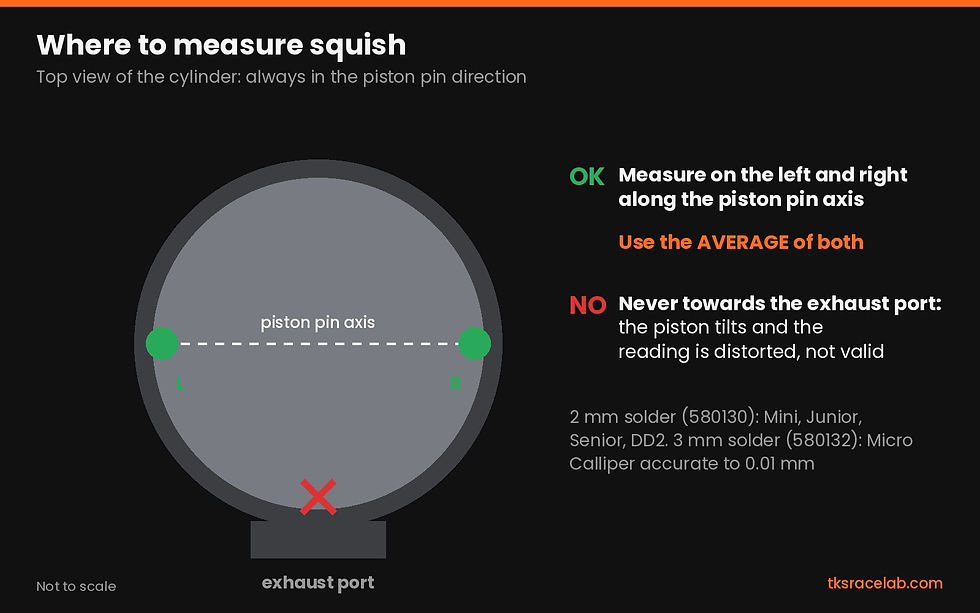
On the DD2 the measurement is the same, only the way you turn the crankshaft changes: remove the M18x1.5 plug and its O-ring with a coin, screw an M8 bolt into the crankshaft and turn it by hand until about 5 mm below top dead centre. Careful: a reading taken towards the exhaust port is distorted by the tilt of the piston and is not valid.
How to correct squish: the cylinder base gaskets
Squish is adjusted with the thickness of the base gasket, between cylinder and crankcase. There are five Rotax cylinder gaskets in the 2026 price list:
• 0.2 mm: code 431337.
• 0.3 mm: code 650480.
• 0.4 mm: code 650483.
• 0.5 mm: code 650481.
• 0.8 mm: code 650482.

A practical example on a 125 MAX: with a 0.5 mm gasket you measure a squish of 0.8 mm, below the Senior minimum. Fitting a 0.8 mm gasket, that is 0.3 mm more, the squish goes up to 1.1 mm. You get the same result with two gaskets, 0.5 and 0.3 mm. It is worth staying a tenth above the minimum, as in this example, because the gasket settles over time.
To change the gasket, the cylinder is removed by unscrewing the four studs. On reassembly: studs into the crankcase with LOCTITE 243 at 5 Nm, a new gasket without damaging it, cylinder and piston lubricated with engine oil, cylinder tightened crosswise to 24 Nm. All the torque values are in the Rotax MAX torque settings table. After the correction, measure the squish again.
You will find the gaskets in the Rotax MAX EVO cylinder gasket kit and, for the DD2, in the complete Rotax DD2 engine gasket kit.
Mistakes to avoid when measuring squish
• Measuring towards the exhaust: the piston tilts and the reading is distorted. Always in the direction of the piston pin.
• Taking only one reading: the average of left and right is what counts.
• Using the wrong solder: 3 mm only on the Micro, 2 mm on all other classes.
• Using an inaccurate calliper: you need at least a hundredth of a millimetre, because the minimum has no tolerance.
• Building the engine exactly at the minimum: the gasket settles and the squish drops.
FAQ on squish on Rotax engines
What should the squish be on a Rotax Senior MAX?
Under the RMC Global Technical Regulations 2026 and the RMCI Italy 2026 regulations the Senior MAX minimum is 1.00 mm, measured with 2 mm solder. It cannot be lower: there is no tolerance.
Is the squish the same on Junior and Mini?
Yes. Junior MAX and Mini MAX have the same minimum of 1.20 mm with 2 mm solder. Bulletin 01 of the 2026 technical regulations also points out that the squish of the two engines is identical.
Why is 3 mm solder used on the Micro MAX?
Because the Micro MAX has a much higher minimum squish, 2.40 mm: with 2 mm solder the measurement would not be possible. The Micro needs 3 mm solder, Rotax code 580132.
Is squish measured on the exhaust side?
No. It must be measured on the left and on the right in the direction of the piston pin. A reading towards the exhaust port is distorted by the tilt of the piston and is not valid.
Can I adjust the squish on my sealed engine?
Squish is inside the engine seal: to change it you have to open the engine. If the seal is broken, the engine must be checked and resealed by an authorised Rotax distributor or one of its service centres.
Does squish change over time?
Yes. The base gasket settles and reduces the squish over time. That is why it should be checked again, especially if the engine was close to the minimum.
Sources: BRP-Rotax, Repair Manual 125 MAX evo and 125 MAX DD2 evo, edition 1 April 2024; Global RMC Technical Regulation 2026, article 5.1, and Bulletin 01; Rotax Max Challenge Italy 2026 technical regulations V2.1; Rotax 2026 spare parts price list.
Questions about this topic?
Message us on WhatsApp: we answer personally, with the experience of people who live at the track. And if you want to drive a real racing kart, with Arrive & Drive you get into one of ours, ready on track. The right spare part? You will find it in the shop.
Arrive & Drive Pro by TKS RaceLab: 2026 karts with Rotax Senior MAX and DD2 engines, Alfano 7 telemetry and trackside technical support at Lonato, Franciacorta, Cremona and Ala. Message us on WhatsApp for information and availability.
TKS RaceLab | Performance Engineering Karting | tksracelab.com
Read also: Rotax engine seal and technical regulations → · Rotax Junior vs Senior MAX evo: differences → · Rotax MAX torque settings → · Rotax engine maintenance → · Rotax technical scrutineering → · Rotax crankshaft →
📞 Contact
📞 +39 352 0280 133
Author: Sergio, TKS RaceLab | Published: 21 October 2026
TKS RaceLab is the Italian online store dedicated to karting: spare parts, accessories and everything you need to get on track. With Arrive & Drive you arrive at South Garda Karting (Lonato), Franciacorta, Cremona or Ala and find your kart ready to go. No hassle, just driving.


Comments