


Kart driver fitness: how to train to drive faster and for longer

Updated: 3 days ago

Anyone driving a racing kart for the first time finds out after a few laps: burning arms, a neck that gives way in corners, shortness of breath. There's no power steering, no suspension, and the forces in corners are much higher than they look from outside. Kart driver fitness isn't only for professionals: it's for anyone who wants to stay precise until the last lap.
In short Driving a racing kart tires forearms, shoulders, neck, core and legs, and keeps your heart rate high for the whole session. Work on grip and forearms, neck, core, legs and stamina, plus mobility and focus. Organise the year in phases: a base in winter, specific work before the season, maintenance during the races. Work with a trainer and a sports doctor.
Why kart driver fitness makes the difference
In corners your neck has to hold your head and helmet against strong lateral forces, your arms have to turn heavy steering and your core has to keep your body still in the seat. Meanwhile vibration goes straight into your hands and back and your heart rate stays high for the whole session. When fatigue arrives, mistakes arrive too: late braking, imprecise lines, lap times dropping off. A trained body lets you stay consistent and clear-headed.

The muscles that really work on track
• Forearms and grip: they hold the wheel for the whole session and absorb vibration.
• Shoulders and arms: they turn the steering, especially in slow, tight corners.
• Neck: it holds your head and helmet against lateral forces in corners.
• Core and intercostals: they keep your body still in the seat. Your ribs work hard: that's why a rib protector is essential.
• Legs: firm, consistent braking needs strength and control.
• Heart and lungs: your heart rate stays high for the whole session, even though you're sitting down.
Driver training: the most useful exercises
These are examples of exercises we use as a starting point with our drivers. Loads, repetitions and progression should be decided with a trainer.
• Grip and forearms: walking with heavy dumbbells in your hands, grip trainers, hanging from a bar.
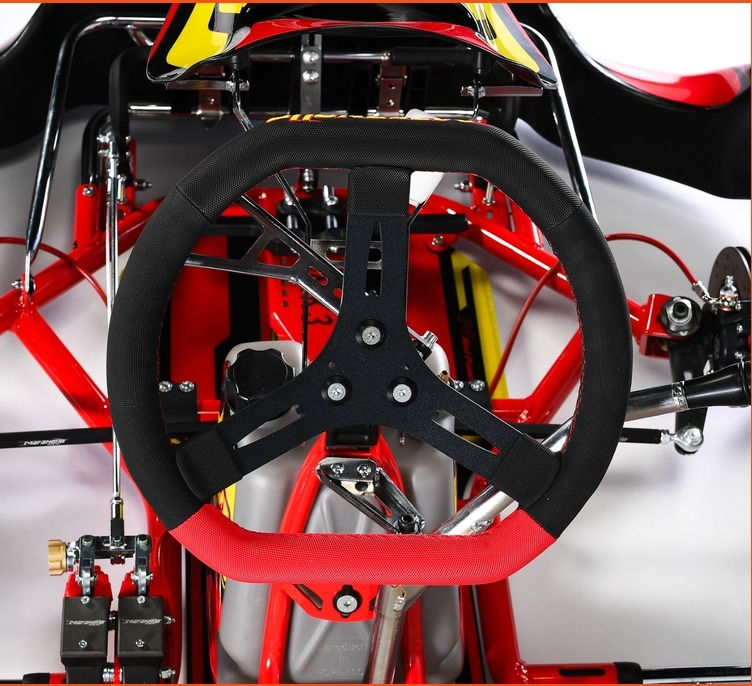
• Steering simulation: hold a gym plate with your arms straight and turn it left and right like a steering wheel, holding the position for a few seconds.
• Neck: isometric exercises with your hand resisting forwards, backwards and sideways, always with controlled movements.
• Core: front and side planks, controlled rotation exercises.
• Stamina: cycling, running or rowing, alternating steady work and more intense intervals.
• Mobility: mobile shoulders, back and hips reduce tension at the wheel.
How to organise your training through the year
• Winter, the base: more general strength and stamina work, when you drive less.
• Pre-season, specific work: exercises closer to driving: grip, neck, steering simulation.
• Season, maintenance: shorter sessions, so you arrive at races rested.
Your driving position matters too: a wrong seat or a wheel that's too far away makes even the fittest driver tire much faster.
Warm-up and recovery at the track
Before going on track do a few minutes of warm-up: neck, shoulder and wrist mobility, a few exercises to activate your arms. Between sessions drink, stay in the shade and let your hands rest. After the day, some stretching helps recovery.
The mind: the training you can't see
Focus, handling pressure and staying clear-headed when tired can be trained like muscles. Reviewing sessions, data and videos helps you understand where to improve: we explain it in the guide on how to really improve your lap time.
The most common kart driver fitness mistakes
• Training only your arms: neck, core and stamina matter just as much.
• Overdoing it before a race: arriving tired at the weekend is worse than not training.
• Ignoring your body's signals: persistent pain in wrists, ribs or neck should be checked by a doctor.
To race in Italy you also need a medical certificate for competitive sport: you'll find all the steps in the guide to the karting licence and in the guide what you need to go karting.
Frequently asked questions
Do you really need to train to drive a racing kart?
Yes. A racing kart has no power steering or suspension: heavy steering, lateral forces in corners and vibration tire your arms, neck and core. A fit driver stays precise and consistent until the last lap.
Which muscles are used most when driving a kart?
Forearms and grip, shoulders, neck, core and intercostal muscles, and legs for braking. Stamina matters a lot too, because your heart rate stays high for the whole session.
How often should you train for karting?
It depends on your level and calendar. For racers, two or three sessions a week of strength, endurance and mobility is a good base. Get a trainer and a sports doctor to build a programme that suits you.
By the TKS RaceLab team, from track experience with our drivers. Before starting a training programme, consult a sports doctor.
Questions about this topic?
Message us on WhatsApp: we answer personally, with the experience of people who live at the track. And if you want to drive a real racing kart, with Arrive & Drive you get into one of ours, ready on track. The right spare part? You will find it in the shop.
Arrive & Drive Pro by TKS RaceLab: 2026 karts with Rotax Senior MAX and DD2 engines, Alfano 7 telemetry and trackside technical support at Lonato, Franciacorta, Cremona and Ala. Message us on WhatsApp for information and availability.
TKS RaceLab | Performance Engineering Karting | tksracelab.com
Read also: Kart driving position: seat, pedals and wheel → · How to really improve your lap time → · What you need to go karting → · Nutrition for karting: what to eat and drink →
📞 Contact
📞 +39 352 0280 133
Author: Sergio, TKS RaceLab | Published: 18 October 2026
TKS RaceLab is the Italian online store dedicated to karting: spare parts, accessories and everything you need to get on track. With Arrive & Drive you arrive at South Garda Karting (Lonato), Franciacorta, Cremona or Ala and find your kart ready to go. No hassle, just driving.


Comments