


The Ackermann Angle on a Kart: Why a Kart Turns Without a Differential

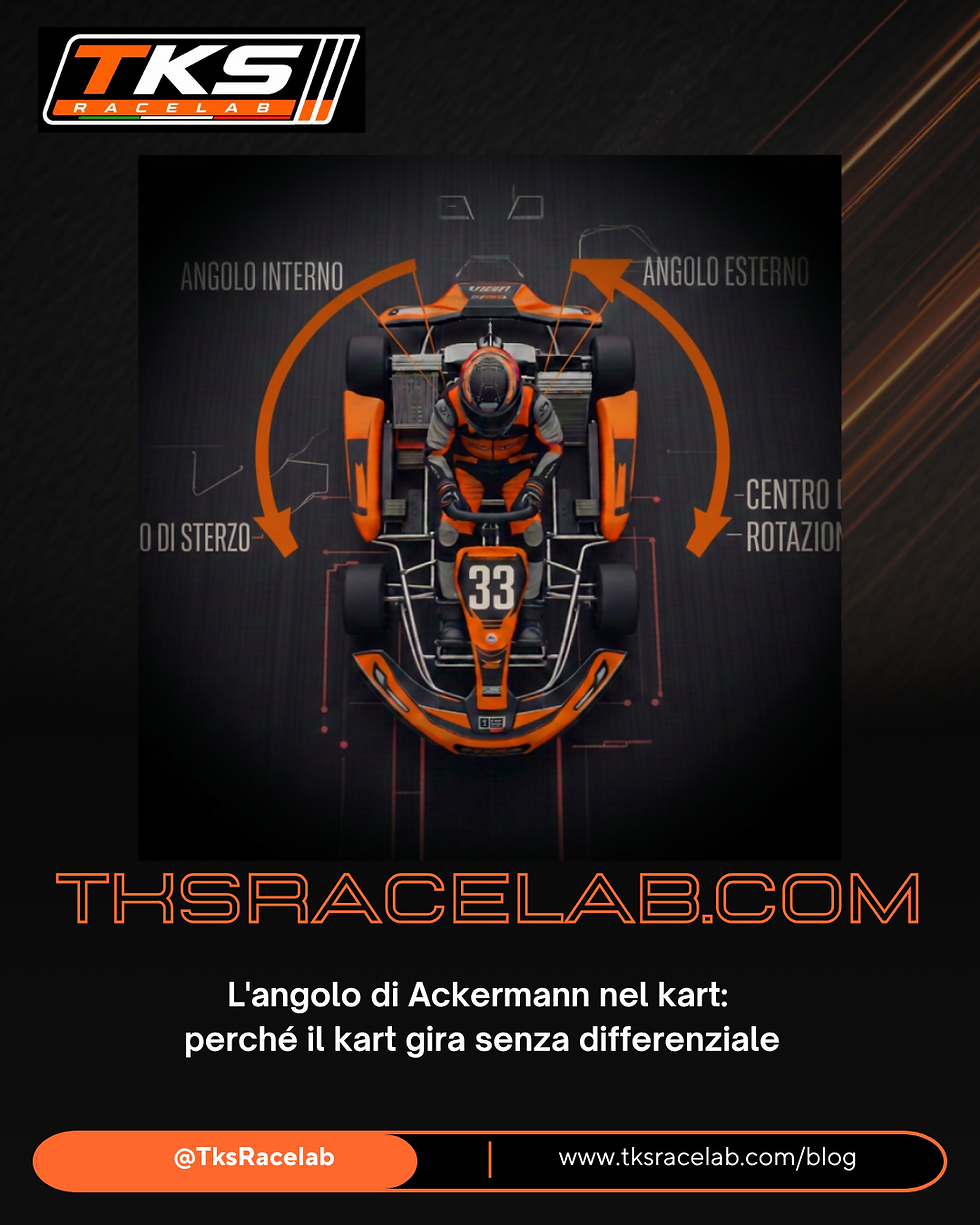
You are going through a tight corner. The kart scrubs a little on the exit, and the front tyres wear on the outside more than they should. You have already checked caster, camber and toe: everything seems normal. But there is something at the basis of how the whole kart steering works, something that comes before those three parameters: it is called the Ackermann angle.
It is the geometric principle that lets the kart go round corners without a differential. In a corner the inside front wheel follows a tighter arc than the outside one: if they turned by the same amount, they would not have a common centre of rotation and the tyres would scrub. Ackermann makes the inside wheel turn more, creates that common centre, and the kart goes through the corner smoothly.
We see it when we prepare chassis: changing the front track width without recalculating the steering geometry is one of the most common mistakes and one of the hardest to diagnose, because the kart simply seems 'strange', with no precise symptom. Understanding Ackermann means understanding why that combination of parameters works
or does not work.
In short Ackermann makes the inside front wheel turn more than the outside one, so the two wheels share a common centre of rotation and the kart corners without a differential. It comes from the chassis C-plates, stub axles, track rods and steering column: changing the front track width without rechecking it is a common mistake.
The problem: the wheels follow different paths
In a corner, the outside front wheel traces a wider arc than the inside one. The two wheels follow circles of different radius.
If they turned by the same amount while staying parallel, they would not have a common centre of rotation. The result: the tyres drag on the tarmac, lose grip and overheat.
A car solves the problem with a rear differential. A kart does not have one: the two rear wheels are rigidly keyed to the same axle. The solution has to come from the front end.
The solution: the Ackermann angle
The Ackermann angle makes the front wheels turn in a non-linear way when you turn the steering wheel. The inside wheel turns more than the outside one, creating a common centre of rotation around which the kart goes through the corner without the tyres scrubbing.
This theoretical centre lies at the point where the axis of the inside front wheel, that of the outside front wheel and the axis of the rear axle intersect.

How this effect is achieved
The mechanism comes from the front-end geometry: chassis C-plates, stub axles, steering track rods and steering column.
The chassis C-plates are the front plates welded to the chassis that hold the kingpins:
the pins around which the stub axles rotate. Each stub axle has an arm pointing towards the inside of the chassis, to which the steering track rods attach. When the steering column turns, the track rods push and pull the stub axles asymmetrically: the inside wheel turns more, the outside one less.
How pronounced this effect is depends on four elements: the geometry of the chassis C-plates, the length and angle of the stub axle arm, the attachment point of the track rod, and the position of the steering column relative to the front axis.
Ackermann and front track width
There is a direct link between front track width and the Ackermann angle. Widening the track, moving the wheels further out, increases the difference in path between the inside and outside wheels. As a result, the additional rotation needed by the inside wheel also increases.
An Ackermann well calibrated to the chosen track width optimises grip and smoothness in corners. Changing one without considering the other is one of the most common setup mistakes we see, especially when moving from a narrow to a wider track width in search of more traction without recalculating the steering geometry.
Why it matters to the amateur enthusiast too
You do not need to be an engineer. You only need to know one practical thing: if the kart jerks or scrubs on corner exit, especially in the tighter corners, one of the factors to check is precisely the steering geometry. Incorrect Ackermann makes the front tyres slide mid-corner, with loss of grip and faster wear.
The most direct way to intervene is to work on the steering column position and the track rod attachment points. Many racing chassis offer multi-adjustable systems precisely for this: they let you adapt the Ackermann to different tracks without changing structural components.

Frequently asked questions
What is the Ackermann angle on a kart?
It is the geometric principle that lets the kart go round corners without a differential. In a corner the inside front wheel must turn more than the outside one to follow paths of different radius. The Ackermann angle provides this effect through the front-end geometry. It is one of the parameters TKS RaceLab assesses in every front-end preparation.
Why does a kart have no differential?
For constructional simplicity, lightness and sporting regulations. The two rear wheels are rigidly keyed to the same axle. The function of the differential, letting the wheels turn at different speeds in a corner, is compensated at the front by the Ackermann angle and at the rear by the flex of the axle. In TKS RaceLab’s Arrive & Drive service, drivers learn to use this characteristic to drive with more awareness.
How does the front track width affect Ackermann?
Widening the track increases the difference in path between the inside and outside wheels, requiring a greater Ackermann correction. Changing the track width without recalculating the steering geometry is one of the most common setup mistakes. At TKS RaceLab the two parameters are always adjusted together.
Can Ackermann be adjusted at the track?
Yes. Racing chassis offer multi-adjustable systems on the steering column and on the track rod attachment points. By varying these references you change the Ackermann according to the track: tight corners require a more pronounced Ackermann than fast tracks with sweeping corners. At tksracelab.com you will find original components for adjusting the steering geometry.
🛒 Steering geometry components available in our shop: adjustable plates, track rods, Maranello stub axles. → tksracelab.com
Conclusion
The Ackermann angle is the answer to the kart’s oldest problem: turning in corners without a differential. Understanding how it works helps you interpret the kart’s behaviour better and work on setup with more awareness.
Find out more: Kart track width: effects on setup and how to adjust it →
Questions about this topic?
Message us on WhatsApp: we answer personally, with the experience of people who live at the track. And if you want to drive a real racing kart, with Arrive & Drive you get into one of ours, ready on track. The right spare part? You will find it in the shop.
Arrive & Drive Pro by TKS RaceLab: 2026 karts with Rotax Senior MAX and DD2 engines, Alfano 7 telemetry and trackside technical support at Lonato, Franciacorta, Cremona and Ala. Message us on WhatsApp for information and availability.
TKS RaceLab | Performance Engineering Karting | tksracelab.com
Read also: Arrive & Drive: how to try a real racing kart without buying one → · Kart geometry: complete guide to caster, camber, toe and Ackermann → · The kart hops (bounces) in corners: why it happens and how to fix it → · Caster, camber and toe: technical guide → · Kart steering track rods → · Kart tyres: the complete guide →
📞 Contact
📞 +39 352 0280 133
Author: Sergio, TKS RaceLab | Published: 10 June 2026 | Updated: 4 October 2026
TKS RaceLab is the Italian online store dedicated to karting: spare parts, accessories and everything you need to get on track. With Arrive & Drive you arrive at South Garda Karting (Lonato), Franciacorta, Cremona or Ala and find your kart ready to go. No hassle, just driving.


Comments