


Kart Track Width: Effects on Setup and How to Adjust It


Track width is the distance between the outer edges of the wheels on the same axle. It is adjusted in the paddock, before every outing, with an Allen key and a tape measure. No expensive components are needed. You need to know exactly what to move, because getting the procedure wrong changes nothing and can unbalance the kart.
We do it systematically on our karts in TKS RaceLab’s Arrive & Drive sessions. Before every outing, track width is checked and adjusted together with the rest of the setup. A few millimetres in the wrong place are felt immediately.
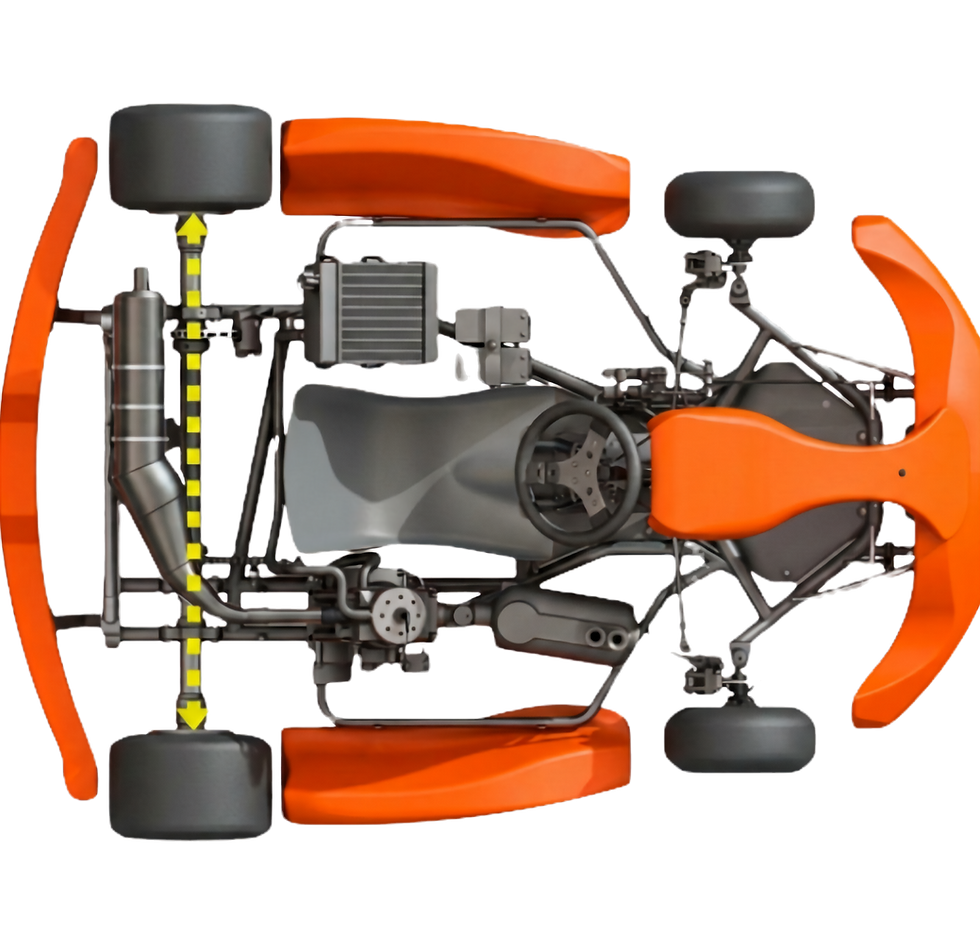
In short Track width is the distance between the outer edges of the wheels on the same axle. At the front it is adjusted by moving the hubs on the stub axles, at the rear by moving the hubs on the axle, which stays fixed. A few millimetres change grip and balance: change one thing at a time.
What kart track width is
Track width is the distance between the outer edges of the tyres on the same axle. It is measured with a tape measure: outer left edge to outer right edge.
In CIK-FIA classes (OK, KZ, all competitive classes) the maximum rear limit is 140 cm. There is no regulatory minimum. But narrowing it too much has precise effects. And they are not good.
Front and rear are not adjusted the same way. They do not have the same effects. And you do not touch one while ignoring the other.
Front track width
On the front axle you work on the hubs, which slide on the stub axles.
The hubs have reference notches. Each notch corresponds to about 5 mm per side. Three notches per side: about 3 cm of total variation.
The effects
Wider at the front: more grip on turn-in, the kart enters corners better
Narrower at the front: the kart understeers, stable on the straight but less reactive on turn-in

Rear track width: the critical point
The axle is fixed in the bearing housings. Moving it sideways is about centring,
not track width.
The rear track width is adjusted by moving the hubs on the axle. The hubs are the sleeves that connect the axle to the wheels.
The procedure
Loosen the grub screws of the left and right hubs (4 or 5 mm Allen key depending on the chassis)
Slide the hubs to the new position on the axle
Check symmetry: equal distance from bearing housing to hub, on the right and on the left
Retighten the grub screws and protect them with insulating tape or cable ties
Why it works like this
What changes is the length of the free section of axle between the outer edge of the bearing housing and the hub. That section determines the flex of the axle.
Wider track: longer section, more flexible axle, less grip, the kart rotates and tends to oversteer
Narrower track: shorter section, stiffer axle, more grip, a tendency to understeer and a risk of lateral hopping over the kerbs
Hub length matters too: longer hubs, for the same track width, stiffen the rear.
When to widen. When to narrow.
Wider rear
High grip, consistent tarmac, fast corners where the kart struggles to turn. It is the most common configuration.
Narrower rear
Wet, slippery tracks, a kart already too lively at the rear. But beware: narrowing too much leads to lateral hopping over the kerbs. Unmanageable.
Wider front
Soft turn-in, slow tracks, a kart that understeers.
Narrower front
Fast tracks, a kart nervous on turn-in, when you want more stability.
The relationship between the two track widths
Front and rear are never touched in isolation.
Every change on one axle shifts the balance with the other. As a starting point, almost all setups use a rear track wider than the front. The balance between the two determines how the kart rotates in corners.
Working on just one and ignoring the other is the most frequent mistake in the first outings.
Frequently asked questions
What changes when you widen the front track?
Front-end grip increases and turn-in improves.
And the rear track?
Narrower makes the rear more planted, with more grip and traction (but it can encourage hopping); wider makes the axle flex more, reduces grip and lets the rear slide more freely.
How much do you adjust it at a time?
A few millimetres at a time, testing on track after every change.
Find out more: Kart geometry: complete guide to caster, camber, toe and Ackermann → · The Ackermann angle on a kart: why a kart turns without a differential → · Kart steering track rods: what they are, when to change them and how to adjust them →
Questions about this topic?
Message us on WhatsApp: we answer personally, with the experience of people who live at the track. And if you want to drive a real racing kart, with Arrive & Drive you get into one of ours, ready on track. The right spare part? You will find it in the shop.
Arrive & Drive Pro by TKS RaceLab: 2026 karts with Rotax Senior MAX and DD2 engines, Alfano 7 telemetry and trackside technical support at Lonato, Franciacorta, Cremona and Ala. Message us on WhatsApp for information and availability.
TKS RaceLab | Performance Engineering Karting | tksracelab.com
Read also: Kart caster, camber and toe: technical setup guide → · Why the kart understeers or oversteers: causes and how to correct the setup → · Why the seat position changes kart setup →
📞 Contact
📞 +39 352 0280 133
Author: Sergio, TKS RaceLab | Published: 10 June 2026 | Updated: 4 October 2026
TKS RaceLab is the Italian online store dedicated to karting: spare parts, accessories and everything you need to get on track. With Arrive & Drive you arrive at South Garda Karting (Lonato), Franciacorta, Cremona or Ala and find your kart ready to go. No hassle, just driving.


Comments