


Alfano 7 Telemetry: What Really Changes on Track

You have finished the session. Your lap time has improved compared with yesterday, but you still do not know why, or where you gained those tenths. This is the situation in which telemetry goes from accessory to real working tool.
In this article we explain what it records, what really changes in your driving when you use it, and how we use it during TKS RaceLab Arrive & Drive sessions.
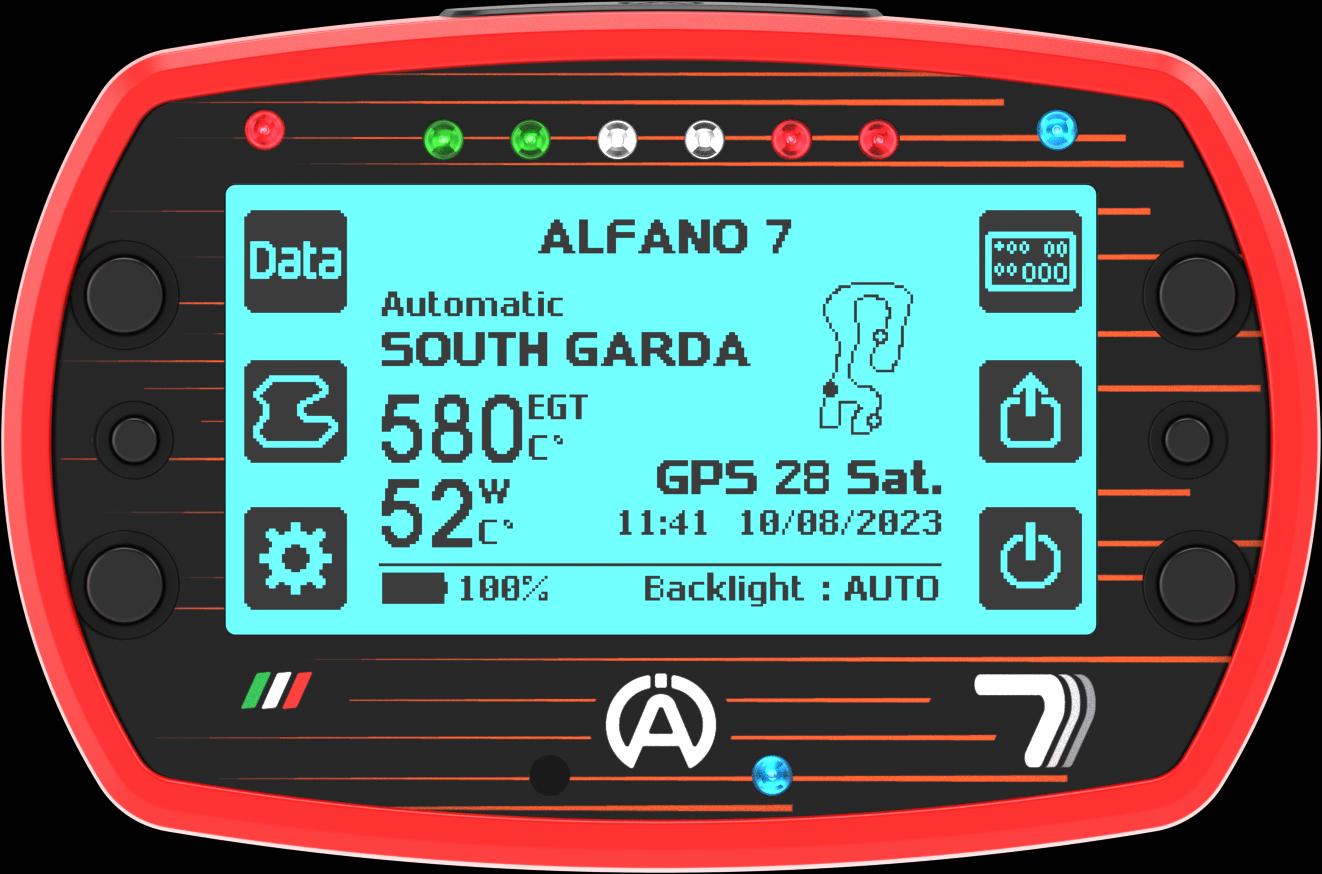
In short The Alfano 7 records GPS speed, engine rpm and temperatures, and with expansions also accelerations, steering and brake pressure. The figure that changes your driving most is the minimum speed at mid-corner: it tells you whether you are entering too fast and losing the exit.
What the Alfano 7 records
The Alfano 7 is a data acquisition system designed specifically for karting. It records GPS speed, engine data (rpm, water temperature, head temperature) and, with expansions, lateral and longitudinal accelerations, steering position and brake pressure. Everything is synchronised to the lap, with a GPS reference of your position on track.
What you see after the session is not just a list of numbers: it is a map of your lap. Where you braked, at what speed you entered the corner, when you got back on the throttle. Compared lap by lap, it tells you precisely where you gain and where you lose.
The figure that really changes your driving
Of all the parameters, the one that produces the most immediate improvement is comparing the minimum speed at mid-corner. Many drivers think they lose time under braking: in reality they lose time on the exit, because they enter too fast and have to correct instead of pushing. The Alfano shows you this clearly, corner by corner.
If you see unusual variations from one lap to the next in the same conditions, you are gathering information you would never have without telemetry. It does not change your driving directly, but it tells you when something is wrong before it becomes a problem.
How we use it in track sessions
In TKS RaceLab Arrive & Drive sessions the karts are fitted with the Alfano 7 and the data is analysed in the pits between one session and the next: this is what makes the difference between a generic session and a session with precise goals.
What we notice on track: drivers who look at the data between sessions tend to show a clearer improvement in pace. Not because telemetry drives for you, but because it removes the guesswork and leaves you only the facts.
What we look at first in the data
The comparison between your best lap and an average lap: the difference is almost never spread over the whole track, it is usually concentrated in two or three corners. That is where the work is done.
The minimum speed at mid-corner and the point where you open the throttle again: they tell you whether you are entering too fast and losing the exit.
Engine rpm on corner exit: if it drops too far, the problem may be the driving but also the gear ratio, and the data helps you understand which of the two.
Water temperature: on the Rotax we keep it between 55 and 60 °C, and telemetry immediately tells us whether we need to act on the radiator.
If you have never used telemetry
One parameter at a time. The first session is for understanding where you are slowest compared with your best lap; from the second you work on one corner only. Correcting everything at once confuses both the data and the feel.
Frequently asked questions
What is telemetry really for on a kart?
It turns the driver’s feelings into measurable data. Lap times, split times, speed and engine rpm make it possible to compare sessions and laps without relying only on impressions.
Does the Alfano 7 also help drivers who are not experienced?
Yes. The data is useful precisely for understanding where you lose time and for checking whether a change in your driving produces a real improvement, working on one aspect at a time.
Does telemetry replace the work of the driver or the technician?
No. Telemetry does not drive for the driver and does not decide the setup: it provides objective data that helps driver and technician better understand what happens on track and check the changes.
Questions about this topic?
Message us on WhatsApp: we answer personally, with the experience of people who live at the track. And if you want to drive a real racing kart, with Arrive & Drive you get into one of ours, ready on track. The right spare part? You will find it in the shop.
Arrive & Drive Pro by TKS RaceLab: 2026 karts with Rotax Senior MAX and DD2 engines, Alfano 7 telemetry and trackside technical support at Lonato, Franciacorta, Cremona and Ala. Message us on WhatsApp for information and availability.
TKS RaceLab | Performance Engineering Karting | tksracelab.com
Read also: Kart axles: soft, medium and hard, what really changes on track → · Magnesium or aluminium wheels: what really changes on the kart → · Flags and track rules: what you need to know before going out →
📞 Contact
📞 +39 352 0280 133
Author: Sergio, TKS RaceLab | Published: 3 March 2026 | Updated: 4 October 2026
TKS RaceLab is the Italian online store dedicated to karting: spare parts, accessories and everything you need to get on track. With Arrive & Drive you arrive at South Garda Karting (Lonato), Franciacorta, Cremona or Ala and find your kart ready to go. No hassle, just driving.


Comments