


Bought a used kart? The checks to do before taking it on track

Updated: 3 days ago

You have bought a used kart and now you want to take it on track. This is exactly the moment to stop for a second: before thinking about setup or lap time, you need to understand what you really have in your hands.
A kart can look perfect standing still and hide wear, play, loose fasteners or postponed maintenance. That does not mean a used kart is a bad buy. It simply means the first day must start in the workshop, not in the pit lane.
This guide starts from the moment after the purchase: the kart is already yours. Let's see what to check, what to replace as a precaution and what is not worth changing if it works properly.
In short Before the track, a used kart must be checked in the workshop: chassis, steering, brakes, transmission, fasteners and engine history. There is no need to change everything at once: replace only what is worn or unsafe. Setup and stopwatch come later.
Used kart: first rule, don't change the setup straight away
The most common mistake is to start immediately with track width, ride height, axle, toe or pressures. If you don't yet know the mechanical condition of the kart, any setup change risks confusing the problem.
First bring it back to a known, safe mechanical condition. Only then does it make sense to look for performance.
1. Chassis: look underneath above all
The paint on top may tell you little. The underside of the tubes tells you much more. Kerbs and contact with the asphalt inevitably wear the chassis: surface scratches are normal, but very flattened or deeply worn areas deserve attention.
Also check welds carefully, the area around the axle bearing carriers, the engine mounts, seat supports and points subject to vibration. A repaired weld does not automatically mean the kart should be scrapped, but you need to know where it is and why it was done.
If you have doubts about the chassis geometry, the serious check is to have its flatness and alignment measured with the right tools. By eye you can spot big problems, not always a smaller deformation.
2. Steering and front end: no play should be ignored
Lift the front end and check each wheel. Move it sideways and up and down: abnormal play can come from bearings, stub axles, kingpins, hubs or rod ends. Then slowly turn the steering wheel from one side to the other: the movement must be free, without sticking.
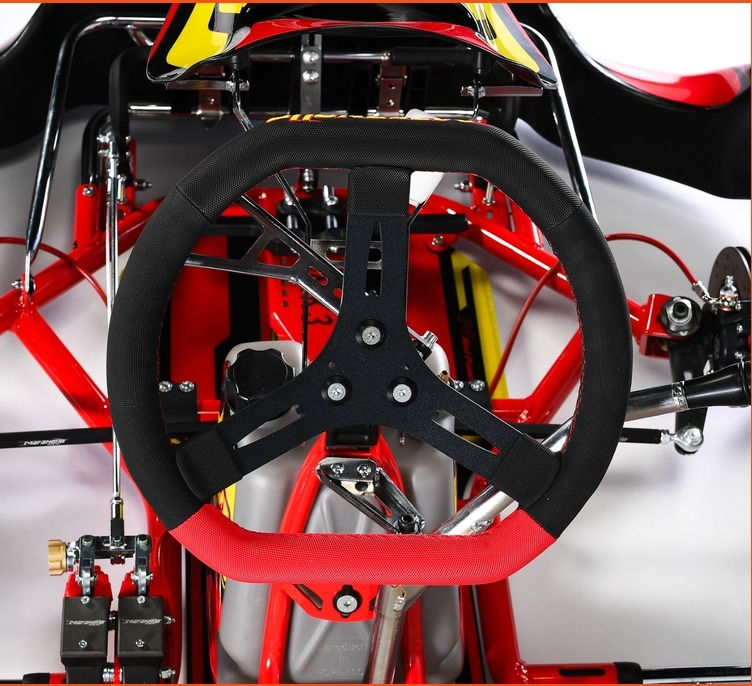
check the steering column and its supports;
check track rods, rod ends and lock nuts;
check stub axles and kingpins;
spin the front hubs and listen for any abnormal noise;
make sure no component is bent or fitted in an obviously asymmetrical way.
A front end with play is not corrected with toe. First eliminate the play, then measure the geometry.
3. Rear axle and bearings
With the chain free and the brake not dragging, the axle must turn smoothly. Rough noise, tight spots or play in the carriers mean you need to look deeper before going on track.
Also check that the axle shows no obvious bends and that grub screws, collars and carriers are correctly tightened. A slightly bent axle can create vibration, wear and handling that is hard to interpret.
4. Brakes: no gambling here
The brake comes before anything else. Check pad thickness and condition, the disc surface, caliper, master cylinder, lines and fittings. Press the pedal firmly and hold it: it must stay firm, without gradually sinking.
Look for any trace of fluid leaks. If the pedal is spongy, the cause must be found and fixed before the track. If you don't know the age of the fluid or the history of the system, a full service is money well spent.
5. Chain, pinion and sprocket: check them together
A new chain on a badly worn sprocket does not solve the problem. Look at the teeth, alignment and tension of the whole transmission. Look for stiff links, damaged O-rings if fitted, pointed or deformed teeth and abnormal play.
If you don't know the history of the chain and it already shows signs of wear, replacing it can cost much less than the damage caused by a failure on track.
6. Seat and mounts: not just a question of position
Check for cracks in the seat, washers, bolts, supports and mounting points. The seat is part of the kart's structure and a makeshift installation can affect both safety and chassis behaviour.
Before moving it because it is "maybe fitted wrong", measure and note the existing position. If the kart comes from a working configuration, having a starting reference is useful.
7. Tank, lines and fuel system
A used kart may have been standing for weeks or months. Check the inside of the tank, the fuel lines, clips, filter and fittings. Hardened, cracked lines or lines of unknown age cost little compared with a leak or a fuel supply problem.
If old fuel is left in the system, don't assume that adding new fuel is enough. Drain and check the system according to the instructions for the engine fitted.
8. If it's a Rotax: find out its history first
On a used Rotax MAX or DD2, the important question is not just "does it start?". You need to know how many hours the engine has, when the last rebuild was done, who did it and which work can be documented.
The engine must have its logbook, stamped and signed, with the purchase date: it is the document that proves where the engine comes from and tells its history. If the seller doesn't have it, consider the engine as having no history and value the price accordingly.
The engine must have intact Rotax seals: check carefully that the seals have not been broken, tampered with or redone. An engine with tampered seals does not comply with Rotax regulations and must be checked and resealed by an authorised Rotax service centre before it can be used in racing.
Check battery, wiring, connectors, spark plug, cooling circuit and possible leaks. Maintenance and intervals depend on the engine's model and version: there is no generic rule that applies to everyone, so rely on a Rotax service centre.
9. Tyres and rims: don't judge by the tread alone
Tyres can still have visible rubber but be old, hardened or have already been through many heat cycles. For a first shakedown outing you don't necessarily need a new set, but you need to know what you are driving on.
Also check the rims: damaged edges, cracks, valves and sealing. If a tyre loses pressure, check the rim and valve too before blaming the tyre.
10. Nuts and bolts: go all the way round the kart
A kart has no suspension and it vibrates. Before the first outing do a systematic check of all nuts and bolts: wheels, hubs, stub axles, track rods, seat, bumpers, bodywork, engine mounts, radiator, exhaust, guards and transmission.
The best method is to always follow the same route around the kart. That way you reduce the chance of missing a fastener.
What to replace straight away and what not
There is no universal list of parts to change as soon as you buy a used kart. It depends on the condition and on the history you can reconstruct.
Replace anything safety-related if it is damaged, doubtful or out of tolerance.
Replace consumables that are worn or whose condition you cannot verify.
Don't change setup components just because they are used: first check they are sound and measure the configuration.
Don't strip a working engine "to be safe" without knowing the manufacturer's intervals and instructions: first reconstruct its history.
The first start-up is not the first test
Once the static checks are done, run a check with the kart raised where appropriate and then a short first session, without chasing lap time. Come back in and recheck leaks, tightness, temperature, chain, brakes and any abnormal sign.
The first laps are for building confidence in the kart. The stopwatch comes later.
The TKS used kart checklist before the first day
Chassis: underside wear, cracks, welds and flatness.
Steering: play, rod ends, track rods, stub axles and hubs.
Rear end: axle, bearings, grub screws and collars.
Brakes: pads, disc, master cylinder, caliper, lines and pedal firmness.
Transmission: chain, pinion, sprocket, tension and alignment.
Seat and mounts: cracks and fasteners.
Fuel: tank, lines, filter and fittings.
Engine: maintenance history, logbook, Rotax seals and the checks required by the manufacturer.
Tyres and rims: condition, age, sealing and damage.
General fasteners: complete check before the track.
Conclusion
Buying a used kart can be one of the best ways into competition karting, but the purchase price is only the beginning. The real value lies in knowing what you have bought. First make the kart safe, mechanically sound and understandable. Then start with setup and the stopwatch. It is a less spectacular order, but it avoids many problems and above all lets you really learn how your kart works.
Before your first outing, also read karting flags and track rules.
Frequently asked questions
I bought a used kart: should I replace all the bearings straight away?
No. First check rotation, play and noise. If they work properly there is no point replacing them just because the kart is used. If instead they are rough, noisy or have abnormal play, look into it and replace them when necessary.
How can I tell if a kart chassis is bent?
Major damage can be visible, but a smaller deformation cannot always be recognised by eye. If the kart shows abnormal wear or you have doubts about the geometry, the right solution is a professional check of flatness and alignment.
Can I go on track as soon as the kart starts?
The fact that the engine starts says nothing about the condition of brakes, steering, chassis, transmission and fasteners. The whole kart must be checked before the track.
What should I ask the previous owner about a used Rotax?
Hours of use, date and type of the last rebuild, any work done, the engine logbook and available documentation, and how long it has been standing. The more you know about the engine's history, the less you have to guess.
Is it worth fitting new tyres for the first outing?
Not necessarily. If the tyres are sound you can use them for a shakedown session, bearing in mind that old tyres or tyres with many heat cycles do not give the grip of a fresh set. When you are looking for performance it is a different matter.
Source: official Rotax manual.
Questions about this topic?
Message us on WhatsApp: we answer personally, with the experience of people who live at the track. And if you want to drive a real racing kart, with Arrive & Drive you get into one of ours, ready on track. The right spare part? You will find it in the shop.
Arrive & Drive Pro by TKS RaceLab: 2026 karts with Rotax Senior MAX and DD2 engines, Alfano 7 telemetry and trackside technical support at Lonato, Franciacorta, Cremona and Ala. Message us on WhatsApp for information and availability.
TKS RaceLab | Performance Engineering Karting | tksracelab.com
Read also: Kart won't start: diagnosis and checks → · Buying your first kart: new or used? → · Before buying a kart: try one on track →
📞 Contact
📞 +39 352 0280 133
Author: Sergio, TKS RaceLab | Published: 18 October 2026
TKS RaceLab is the Italian online store dedicated to karting: spare parts, accessories and everything you need to get on track. With Arrive & Drive you arrive at South Garda Karting (Lonato), Franciacorta, Cremona or Ala and find your kart ready to go. No hassle, just driving.


Comments